

Kiên tâmtạo giá trị
Solving Technical Challenges Beneath the Saigon River
The Saigon River pedestrian bridge is being constructed in the heart of the city, along an important waterway, with stringent requirements for aesthetics, navigational clearance, and schedule. As a result, the project’s challenges lie not only in its structural solutions, but also in organizing construction within a constrained worksite while simultaneously ensuring construction progress, quality, and occupational safety, and maintaining uninterrupted road and waterway traffic day and night.
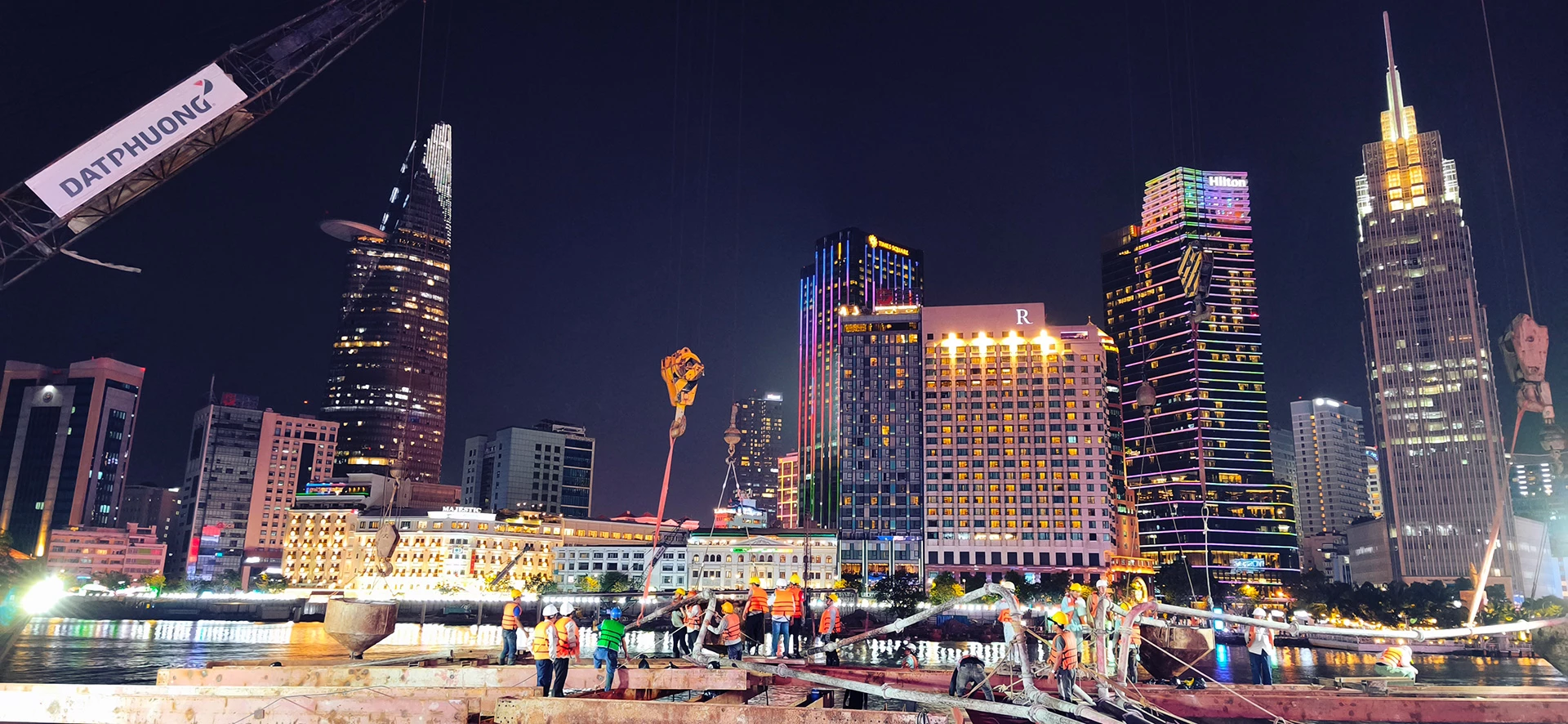
The Saigon River pedestrian bridge construction site presents the challenge of working in a densely trafficked urban environment.
Dat Phuong is participating in the project with bored piles, bridge abutments, and the two main pier foundations, TC1 and TC2. Among these, the TC2 pier foundation presents particularly challenging construction conditions, as the entire structure is located beneath the riverbed, at a depth of approximately 8 meters.
The foundation is 48.5 meters long, 39 meters wide, and 3 meters high, with an area of nearly 1,892 square meters. It requires approximately 650 tons of steel and more than 5,674 cubic meters of concrete. However, the sheer volume of work is not the only factor contributing to the complexity of this component. The greater challenge lies in organizing an underwater construction site, lowering materials and equipment to below-ground elevation, while simultaneously controlling structural stability, water flow conditions, and concrete quality throughout the construction process.
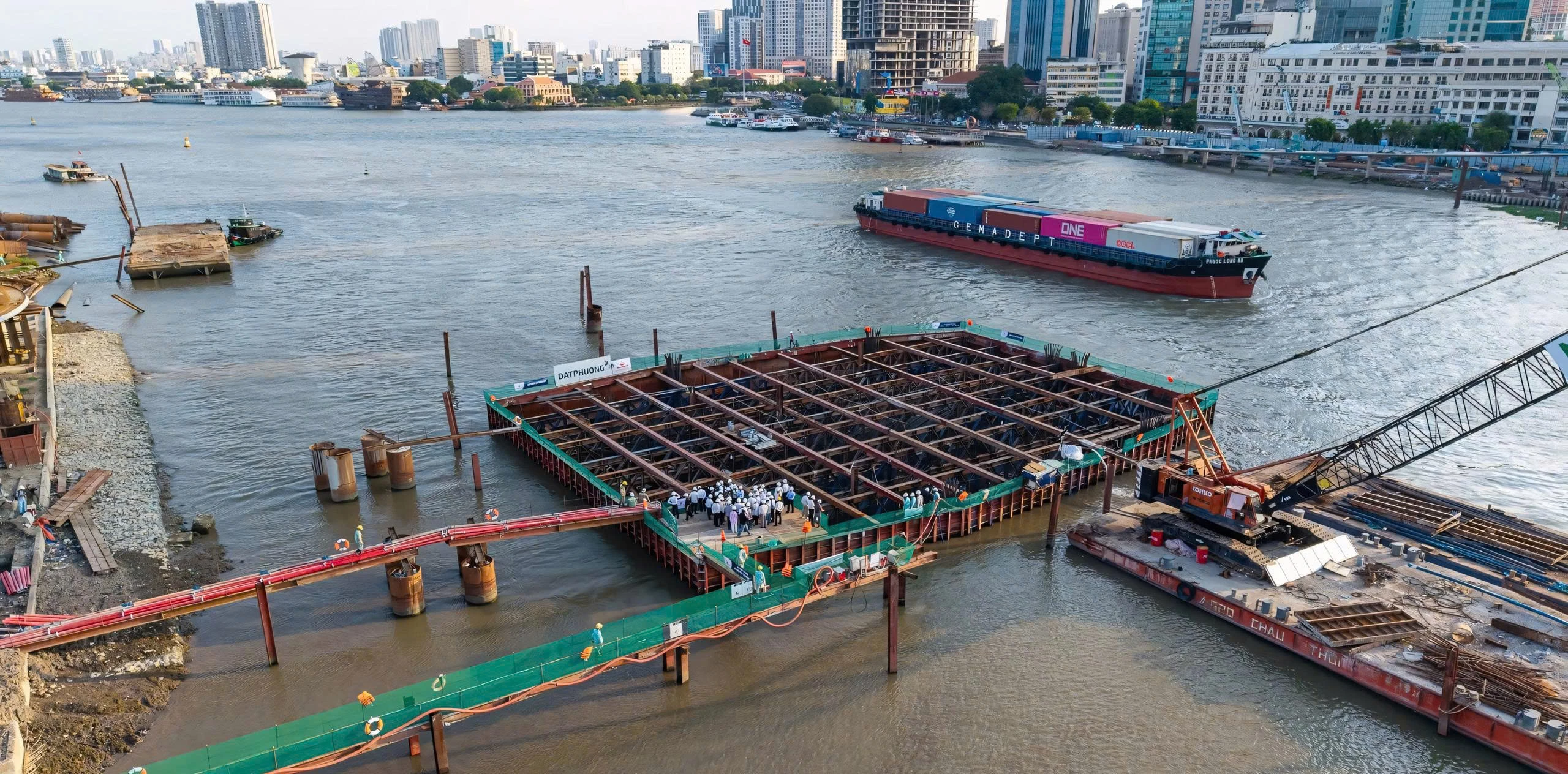
Constructing the TC2 pier foundation at a depth of approximately 8 meters beneath the river requires appropriate structural and construction solutions.
At such a depth and within a confined working space, construction activities cannot be carried out in the same manner as on land. Heavy-duty cranes are deployed to handle and retrieve obstructions, while divers directly inspect and address foundation conditions underwater. Multiple construction fronts are operated simultaneously to maintain progress.
The specific conditions of the site require the project management team to adopt a flexible construction approach, addressing emerging conditions on site while maintaining the planned construction fronts. In an underwater environment, any changes in water flow, geology, or working conditions can directly affect the construction method and the schedule of the work.
Under the design, the pier foundation is positioned beneath the riverbed, both to ensure aesthetic requirements and keep the river surface unobstructed, while also helping protect the bridge’s arch structure from potential collisions with vessels.
To execute this component, Dat Phuong applies a cofferdam construction method using a formwork system approximately 8 meters high with a two-level framing structure. The solution requires stringent calculations for the load-bearing capacity and stability of the structural system in a water environment, where water levels and flow pressure directly affect the construction area.
For the large volume of concrete, technical requirements extend beyond simply ensuring that sufficient material is available for a single pour. Concrete temperature, mix design, delivery time, and pumping rhythm must be controlled simultaneously to minimize risks during construction. Extended overnight shifts require the supply of materials, equipment and manpower, as well as technical supervision, to operate continuously and in coordination.
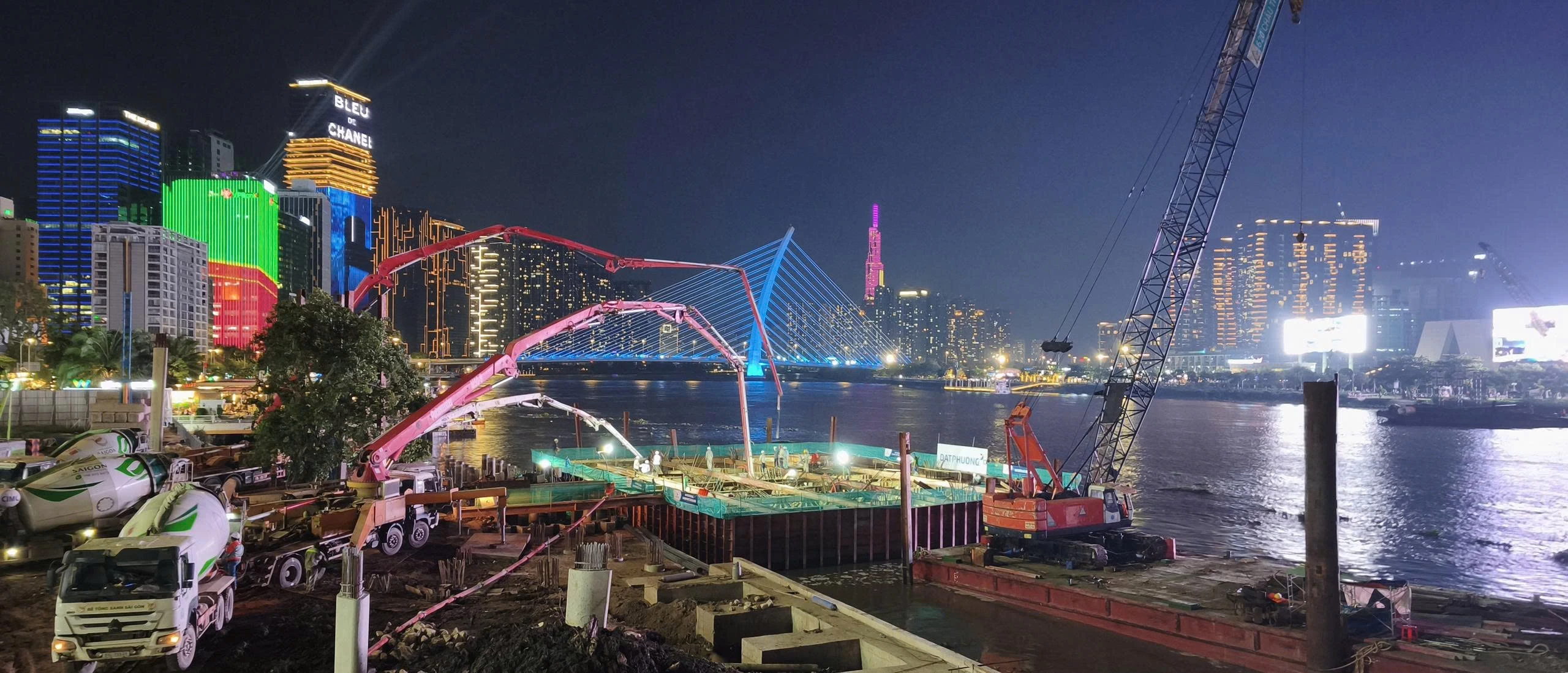
Mastering technical solutions, organizing resources, and simultaneously controlling progress, quality, and safety on site.
The complexity of the TC2 pier foundation therefore does not stem from any single parameter, but from the combination of multiple factors: underwater construction, complex foundation conditions, the requirements of mass concrete control, and schedule pressure in an environment where safety and active waterway traffic are critical considerations.
Expanding the Capability Zone
The specific conditions at the Saigon River pedestrian bridge illustrate how the requirements placed on contractors are evolving. For large-scale infrastructure projects, financial capacity, equipment, and human resources form the foundation. However, to turn these resources into construction efficiency, contractors must also possess the ability to organize operations and master technical solutions and technologies suited to actual site conditions.
A major construction site cannot operate through isolated resources alone. Technology must work in conjunction with equipment; equipment must be deployed according to the construction method; personnel must be capable of implementing the required technical solutions; while materials, schedule, quality, and safety must be controlled within an integrated system.
At the Saigon River pedestrian bridge, this requirement is reflected across components ranging from large-diameter bored piles and bridge abutments to the pier foundation submerged beneath the riverbed. Each component presents its own technical requirements, while all must be organized within a unified overall plan to ensure the project’s progress and quality.
This is also the distinction between possessing resources and being able to transform those resources into actual construction capabilities. Before implementation, the contractor must select an appropriate solution; during construction, equipment, personnel, and materials must be organized according to specific conditions; and when unexpected changes arise, the contractor must be able to adjust the construction approach while maintaining control over quality, safety, and schedule requirements.
In an era of rapid infrastructure development, projects are becoming larger in scale, more complex in structure, and increasingly implemented in challenging geographical and geological conditions. The scope of a contractor’s capabilities is therefore expanding as well. The measure of capability is no longer simply the ability to execute a large volume of construction work, but also the ability to solve construction challenges for which no ready-made formula exists.
For Dat Phuong, participating in the construction components of the Saigon River pedestrian bridge represents another step in the company’s ongoing expansion of its infrastructure construction capabilities, building on large-scale projects while taking on increasingly complex challenges in structural engineering, technology, and construction organization.
In this process, each project, with its own geographical, geological, and technical conditions, becomes a new test of the contractor’s capabilities. The ability to master technology, organize resources, and control variables on site will increasingly become a decisive factor in enabling contractors to meet the evolving standards of infrastructure construction.
